BlogLearning at homeLire en français
How Many Arabic Words Does Your Child Really Need?
Everyday words, stories to share and a careful look at vocabulary research.

Your child’s Arabic journey starts with 50 carefully chosen everyday words.
If you’ve ever opened an Arabic dictionary, you know the feeling. Tens of thousands of words, roots branching into more words, and a child who just wants to know how to say “cat.” Where do you even start?
A useful starting point is a small selection of words that children can meet in everyday situations.
What the research says
In one study of a large Arabic web corpus, Ahmed Masrai and Jim Milton examined how frequent lemmas contribute to text coverage.
In that study, the 5,000 most frequent lemmas covered about 89% of the text. Coverage varies with the texts and how words are counted; it does not guarantee comprehension.
Our stories introduce everyday words in context. Our planned vocabulary is not claimed to reproduce that study’s frequency list.
What it doesn’t mean
Text coverage is one way to describe a corpus, not a promise about what a child will understand.
Spoken Arabic adds another layer. Families use Lebanese, Egyptian, Moroccan, Iraqi and many other dialects. A finding about written Arabic does not automatically describe those conversations.
A vocabulary total is not a finish line. Children can explore one word at a time.
Why start with 50?
About fifty new words is the planned focus of each of the first 40 Wagon Path levels (Levels 41 to 68 plan about 105), not a promise of mastery at a particular age.
Wagon Path is a planned series of stories with vocabulary, pronunciation guidance, tracing and games. Its first level is planned around 50 words; the books and supporting activities are still being prepared.
Our planned 68-book Wagon Path introduces nearly 5,000 carefully chosen everyday words, from age 5 to 12. This planned pathway is separate from the Christmas story currently available on this site.
You don’t need to speak Arabic to help
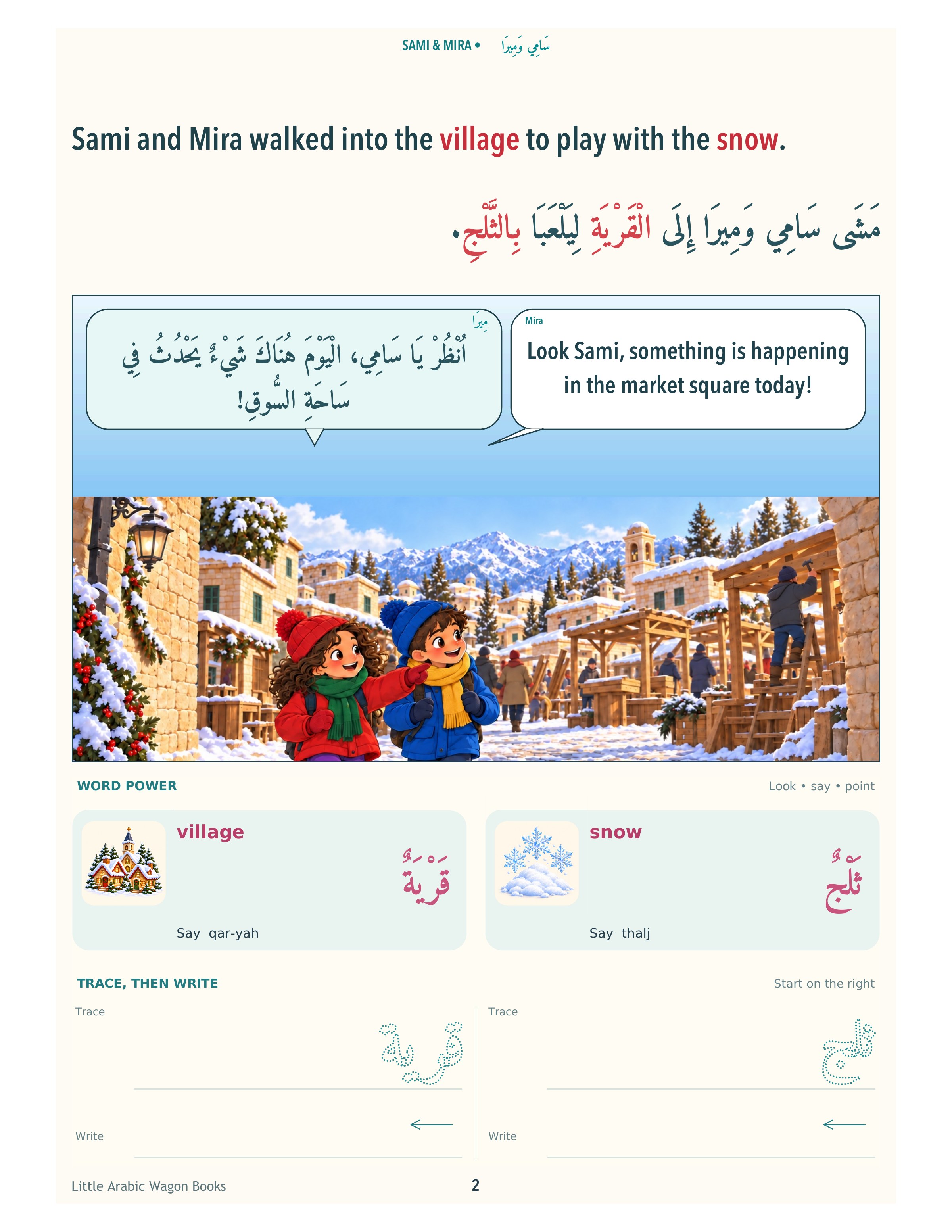
You can explore the Christmas story in English–Arabic or French–Arabic, with pronunciation hints beside its Word Power vocabulary. Read together and try the words at your own pace.
Try this at home
A few tips that help
- Choose a short reading time that works for your family.
- Invite your child to try explaining a word to you.
- Use a word outside the book when you notice a matching object or action.
- Return to a familiar story and see which words your child notices.
Try a free sample
Explore a sample of our Christmas story in the edition you choose.
Key takeaways
- Start small: about 50 everyday words is a friendly first step.
- Word counts describe texts, not what a child understands — context and conversation matter too.
- You don’t need to speak Arabic to help: read together, use words in daily life and come back to favourite stories.
Sources
Email news
Get the next post by email
A new Arabic activity for your family every two weeks.
Sign up and get a free printable Arabic activity pack right away.
Screens off, Arabic on.
When tablet time is over, the learning doesn’t have to stop. Print a few pages of Sami and Mira’s words — cards, tracing and matching games for the kitchen table.
Free taster: 5 printable pages · Ages 5–8 · Levels 1–20
Please enter a valid email address.Please tick the box to get the free pack.Something went wrong. Please try again in a moment.Your free activity pack is ready. Print it now: the pages are just below.We have also emailed you the link. If you don’t see it, check your Promotions or spam folder.Open the pack on its own pagePrint / Save as PDF

Keep reading
Books to start with
Bilingual picture books with the Arabic words, pronunciation and games built in.